Can the church influence lasting governmental change?
Jul 15 in General
This year we sold our home and after a number of setbacks and disappointments we ended up buying what we said we never would: a renovation project! and so I find that when people ask me, how are you doing? I reply: “I am learning to live with uncomfortable” followed by: “haha, there’s probably a lesson God is wanting to teach me in all this!” 👀
I then began to realise just how far-reaching this “learning to live with uncomfortable” has become. Every time I listen to the news, I’m uncomfortable. Every time I watch a film, scroll social media platforms, listen or partake in certain conversations, I’m uncomfortable … and so I find I’m living with “uncomfortable” far more than I realised!
That discomfort, I now understand points to what is called Cognitive Dissonance – that internal tension that is created when our values are at odds with what we see happening around us which for the most part, we are trying hard to ignore – If left unaddressed it can then lead to justification, rationalisation, normalisation, trivialisation and denial / or irrational behaviour.
A line from the film: ‘Leave the world behind’ really struck me ‘The highest form of warfare is not to fight at all but to subvert anything of value in the country of your enemy’
That’s when I stumbled across an article by an ex KGB agent (as you do!) on how the KGB use psychological and ideological subversion and propaganda as a form of warfare to destabilise societies from within – it outlined 4 stages:
1. Demoralisation – tearing at the moral fabric of a society through their media cultural platforms and influencing minds – especially of young people – with disillusionment; making them question all traditional values with the aim to create instability and disorientation.
Benjamin Disraeli said: ‘The Youth of a Nation are the trustees of posterity’
2. Destabilisation – creating a state of crisis, fostering insecurity, polarisation, economic and social unrest … (any of this “uncomfortably familiar?”).
3. Crisis – driving chaos, using fear and propaganda to manipulate and control, causing a lack of trust in institutions and political upheaval.
4. Normalisation – is when all this becomes the norm, erasing its original cultural identity.
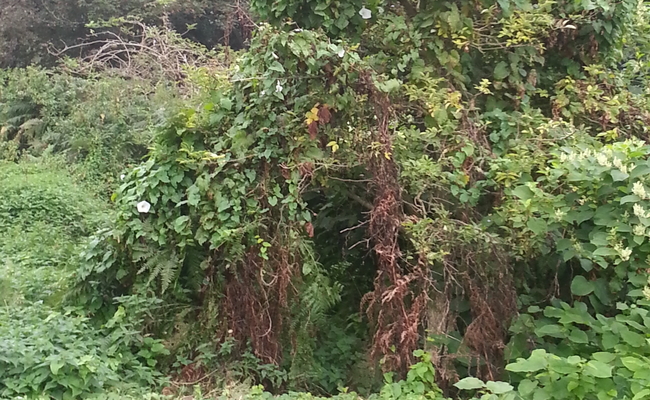
* In my wild new garden, I have a plant that is being completely swallowed up beneath an invasive plant. Though often fragrant or attractive, invasive plants are deceptively destructive—spreading fast, they’re aggressive and hard to control, affecting ecosystems, and forming monocultures by not allowing anything else to grow. They are nearly impossible to get rid of.
Winston Churchill said: ‘one of the great signs of a great society is the diligence with which it passes culture from one generation to the next. This culture is the embodiment of everything the people of that society hold dear: its religious faith, its heroes … When one generation no longer esteems its own heritage and fails to pass the torch to its children, it is saying in essence that the very foundational principles and experiences that make the society what it is are not longer valid. This leaves that generation without any sense of definition or direction, making them the fulfillment of Karl Marx’s dictum ‘A people without a heritage are easily persuaded’, what is required when this happens and the society has lost its way, is for leaders to arise, who have not forgotten the discarded legacy and who love it with all their hearts. They can then become the voice of that lost generation, wooing an errant generation back to the faith of their father, back to the ancient foundations and bedrock values …’
We are in a battle for TRUTH – not just as an idea but as a stronghold. Just like our invasive plant, that began as a little shoot – A spiritual stronghold begins small, with a pattern of behaviour – a thought – which creates an atmosphere, then a climate (now it’s permanent) and eventually a belief system (a system of thinking) which if sustained becomes a stronghold – a place from which one can rule – which once maintained becomes a culture – a Kingdom Culture – whether rooted in truth or lies.
Paul tells us in 2 Corinthians 10 “our weapons are not of the flesh, but divinely powerful for demolishing strongholds. We are to tear down arguments and take every thought captive…” We are to build strongholds of truth that are based on His Word.
Just like my renovation project, where we are going to have to rewire, tear down, replace, build and restore – for the consequences of doing nothing are too frightful to consider.
This battle is for ourselves, our families, communities, society, our nation, and we need to be aware of the power we have for change and the impact we can have on the world around us.
The church, if united in one accord, could become the greatest voice to influence legislation in this nation. As the *ekklesia* we are called out to be ambassadors, representatives of another Kingdom. Establishing truth. Developing Kingdom Culture.
Living as a christian in today’s secular world can be challenging. Clifford Hill in his book ‘Living in Babylon’ reminds us that we are called to remain faithful to God while navigating a culture that often contradicts our beliefs. He encourages Christians to hold on to their values, even when society pressures us to conform.
We can create political, cultural and ideological transformation by reclaiming our voice, restoring Godly values and reshaping culture. When we build strongholds of truth, in our minds, homes and communities we don’t just resist ideological subversion but create a political shift which is able to influence legislation, furthermore culture; bringing Heaven’s values into earthly places.
So YES, I’m learning to live with uncomfortable. But I believe discomfort can be an invitation – a call to awaken, rebuild and reclaim truth.
‘He who controls the mind of a nation, controls the land’ … let it be GOD!
** To clarify: When I mention the word ‘ekklesia’ I am referring to the original Greek meaning of the word for Church meaning: ‘an assembly that is called out to live amongst and impact their surroundings’ – Whenever the Romans took over a territory, they would then establish an ekklesia – a representative group of government that enacted the policies of Rome in that region by influencing the population with the new rules and ideologies of the Roman Empire. As the ekklesia we are called out to be ambassadors, representatives of another Kingdom and entrusted (2 Corinthians 5:20) with His message of reconciliation.